
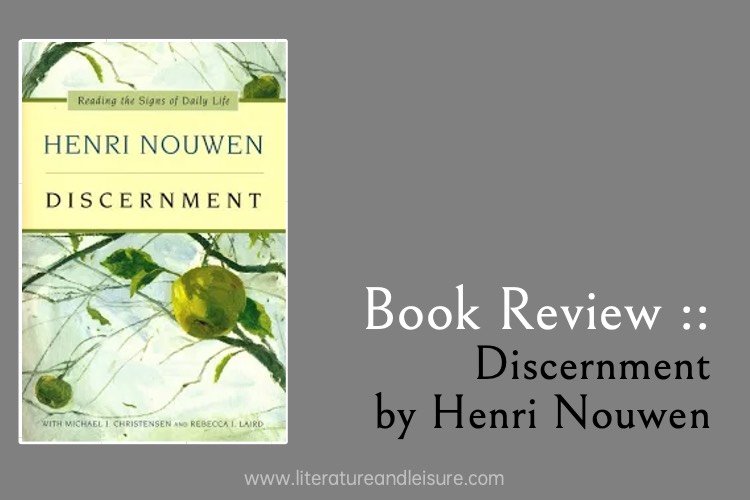
Every now and then, I read a book that makes me want to slow down—not because it is difficult to read, but because it asks me to pay closer attention. Discernment: Reading the Signs of Daily Life by Henri Nouwen was one of those books.
It is a beautiful exploration of how and when the Holy Spirit speaks to us, and how to become more attentive to those messages. The book begins with the very basic question, “What is discernment?” and gradually leads the reader into exploring the many different sources through which we might hear from the Spirit. Some of them are probably what you would expect—spiritual writings and Scripture, for example. Others are less obvious: nature, the people in our lives, and even current events.
I absolutely loved this book when I first read it. I happened to be reading it at the beach, which made the chapter “Read the Book of Nature” especially meaningful. When I was sitting with a view of the ocean while reading Nouwen write, “God’s first language is nature” – nothing could have felt more true.
Nouwen didn’t actually write Discernment as a book. Two of his students compiled it from his journals, essays, lectures and other writings, including some material that had never been published before. Despite that, the book flows remarkably well. Everything feels connected by this central idea of learning to recognize God’s presence, voice and direction in the ordinary circumstances of our lives.
Each chapter also ends with several “Exercises for Deeper Discernment,” which make this a particularly good choice for a small group or Bible study. The exercises aren’t simply comprehension questions; they invite you to actually practice what Nouwen is talking about.
A Different Kind of Book Club Pick
Discernment is very different from what my book club typically reads. We read a lot of literary fiction, so a book about spirituality and the Holy Spirit isn’t exactly our usual fare. But because I loved it so much, I decided to pitch it as one of our selections this year.
Surprisingly, it was selected!
We read it in July and had an amazing discussion. In the end, though, we decided not to rate it. Our book club has a fairly elaborate rating system, but we agreed that Discernment was different enough from our typical selections that our normal scale just didn’t seem applicable. It wasn’t a matter of whether we liked it more or less than the other books we’d read. It was simply asking us to consider something different.
Wrestling With Our Differences
Nouwen was a Catholic priest, and some of our discussion naturally centered on the places where his Catholic theology was different from the traditions and beliefs of some of our group. (And, naturally, our one Catholic member wasn’t there for the discussion!)
Praying to the saints was one example that generated some conversation. But I appreciated that the book gave us room to talk about those differences without them becoming the point of the discussion. We could wrestle with ideas that weren’t necessarily familiar to all of us while still engaging with the larger questions Nouwen was asking.
That, to me, is one of the great things about a book club: Sometimes the best discussions aren’t the ones where everyone agrees.
The Exercises
We also talked about the various exercises we had tried from the book.
One of the most interesting asks you to chart your own life alongside the significant events happening in the world at the same time. A couple of our members talked about how meaningful this exercise had been for them.
They had given birth to their children around September 11, 2001. On one side of their timeline was an incredibly personal and joyful event—the birth of a child. On the other was a moment when the world seemed to descend into chaos and uncertainty.
Looking at those two things alongside one another helped them make sense of how those seemingly contradictory experiences could coexist: profound personal joy in the midst of profound collective grief and fear.
That exercise captured something I think Nouwen does particularly well. Discernment isn’t necessarily about finding an obvious explanation for everything that happens. Sometimes it is about looking back at our lives and noticing connections, patterns and moments of meaning that we couldn’t see at the time.
Vocation and Identity
Two chapters that were especially meaningful to me were the ones on vocation and identity.
Those are questions that feel particularly relevant to me right now. Knowing that, in probably just a few years, I will be making the transition from a career to retirement, I’ve been thinking more about what work has meant to me—and what it will mean when it is no longer such a defining part of my life.
Nouwen’s discussion of vocation challenged the idea that vocation is simply synonymous with a career. What are we called to do? Who are we called to be? And how do we understand our identity when the roles that have defined so much of our lives change?
Those aren’t questions I have completely answered. But perhaps that’s part of the point.
Discernment isn’t always about arriving at an answer. Sometimes it is a journey where becoming more attentive to the questions is real purpose.
The Vulnerability of Henri Nouwen
Another thing our group really appreciated about Discernment was how vulnerable Nouwen was in his writing.
He openly discussed his personal struggles, his failures, his doubts and his misgivings. And, importantly, many of those struggles didn’t come with a tidy bow at the end.
You get the sense that some of these were struggles he wrestled with throughout his life.
We found that incredibly refreshing.
The authors of many religious books can sometimes seem to have arrived at the other side of faith, as though they have figured everything out and are now graciously passing along the answers. Nouwen doesn’t come across that way. Instead, he feels deeply human.
He is a priest and a spiritual teacher, but he is also someone who struggles, questions, fails and tries again.
That vulnerability made his writing feel more accessible to me. He wasn’t writing from a place of having conquered doubt or uncertainty. He was writing from within the struggle.
And perhaps that makes his invitation to discernment all the more compelling.
Learning to Pay Attention
What I took away most from Discernment is that discernment isn’t necessarily some dramatic spiritual experience. It can be much quieter than that.
It is the practice of paying attention – to a passage of Scripture that suddenly speaks to something happening in your life, to noticing something in nature. It may be really listening to the people around you or looking at your life circumstances alongside what is happening in the world. It can even be recognizing that a question you keep returning to may be worth sitting with rather than immediately trying to answer.
In other words, discernment requires attention.
And I think that’s part of why this book stayed with me. In a world that constantly asks us to move faster, Nouwen encourages us to slow down enough to notice what is already happening around us—and hearing what the Holy Spirit has to say within us.
Book Club Discussion
This book suits itself very well to a small group or Bible study, and if that’s the case, I would recommend taking it chapter by chapter for either ten weeks or five weeks, reading two chapters at a time. In that case, a deeper discussion of the chapters as well as the proposed exercises would provide for a great discussion.
If your group – like mine – discusses it in its entirety in one session, here are some questions to consider.
- Nouwen writes that discernment is about recognizing the movement of God’s Spirit in our daily lives. Have you ever experienced a moment that only made sense in hindsight?
- What idea in the book challenged you the most? Was there anything you found difficult to accept or put into practice?
- Nouwen encourages listening more than striving. Do you find it easier to act or to wait? What makes discernment difficult in today’s world?
- How do you distinguish between your own desires, fear, and what you believe God is calling you toward?
- Nouwen suggests that discernment happens in community as well as in solitude. Which comes more naturally to you, and why?
- The book emphasizes paying attention to ordinary moments rather than waiting for dramatic signs. How does that change your understanding of God’s guidance?
- What role do silence and prayer play in your life? Did this book make you want to change those practices?
- Did you think the book was more practical or more inspirational? Were there any tools or practices you wished Nouwen had developed further?

Comments
Powered by Facebook Comments